For many small activities, the difference between simplified and organised accounting is modest at lower income levels.
But once revenue increases (or your cost structure changes) the choice can significantly affect how much tax you end up paying.
At that point, your choice of accounting regime directly affects your net income.
First: What’s the Actual Difference?
In Portugal, freelancers can operate under one of two regimes:
1) Simplified Regime (Regime Simplificado)
Instead of deducting your real expenses, the tax authority considers a fixed percentage of your income as profit. The remaining portion is assumed to cover expenses.
In this regime, your taxable profit is:
- 75% of revenue for most service activities
- 35% of revenue for short-term rental activities
- 15% of revenue for activities involving the sale of goods, restaraurants and hotels
Compliance requirements are lighter because full accounting records are not required.
2) Organized Accounting (Contabilidade Organizada)
You are taxed on:
Revenue – Actual Expenses = Taxable Profit
This requires a certified accountant and formal bookkeeping.
Organized accounting becomes mandatory for freelancers with an annual turnover exceeding €200,000 for two consecutive years or €250,000 in a single year.
When Is the simplified regime efficient
If:
- Revenue is still relatively low
- Your real expenses are minimal
- You do not carry payroll or significant recurring business expenses
- You don’t need bank financing
The simplified regime is often efficient and operationally simple.
In early-stage freelancing, complexity rarely produces better results.
When can the simplified regime become inefficient
The decision becomes relevant when one or more of the following happens:
1) Your Expenses Are High Relative to Revenue
If your real business expenses exceed the assumed percentage under the simplified regime, you may be overpaying tax.
Situations that often indicate a higher-cost business structure include:
- equipment-heavy activity
- subcontractors
- office rent
- employees
- significant travel costs
In these cases, organized accounting may reduce taxable profit.
2) Your Revenue Increases Significantly
As income grows, small percentage differences can translate into large differences in the total tax paid.
At higher income levels:
- marginal IRS rates increase
- social Security contributions rise
- planning becomes more relevant
A regime that was efficient at €30,000 may not be efficient at €90,000.
3) You Plan to Transition to a Company
If incorporation is likely within 1–2 years, organized accounting may create a longer and smoother financial history of your activity, which facilitates discussions with investors, banks, or future partners.
4) You Want Strategic Oversight
The simplified regime is administratively lighter.
But organized accounting provides:
- formal profit measurement
- better financial visibility
- clear cost tracking
- stronger documentation for financing
A Practical Example
Assuming:
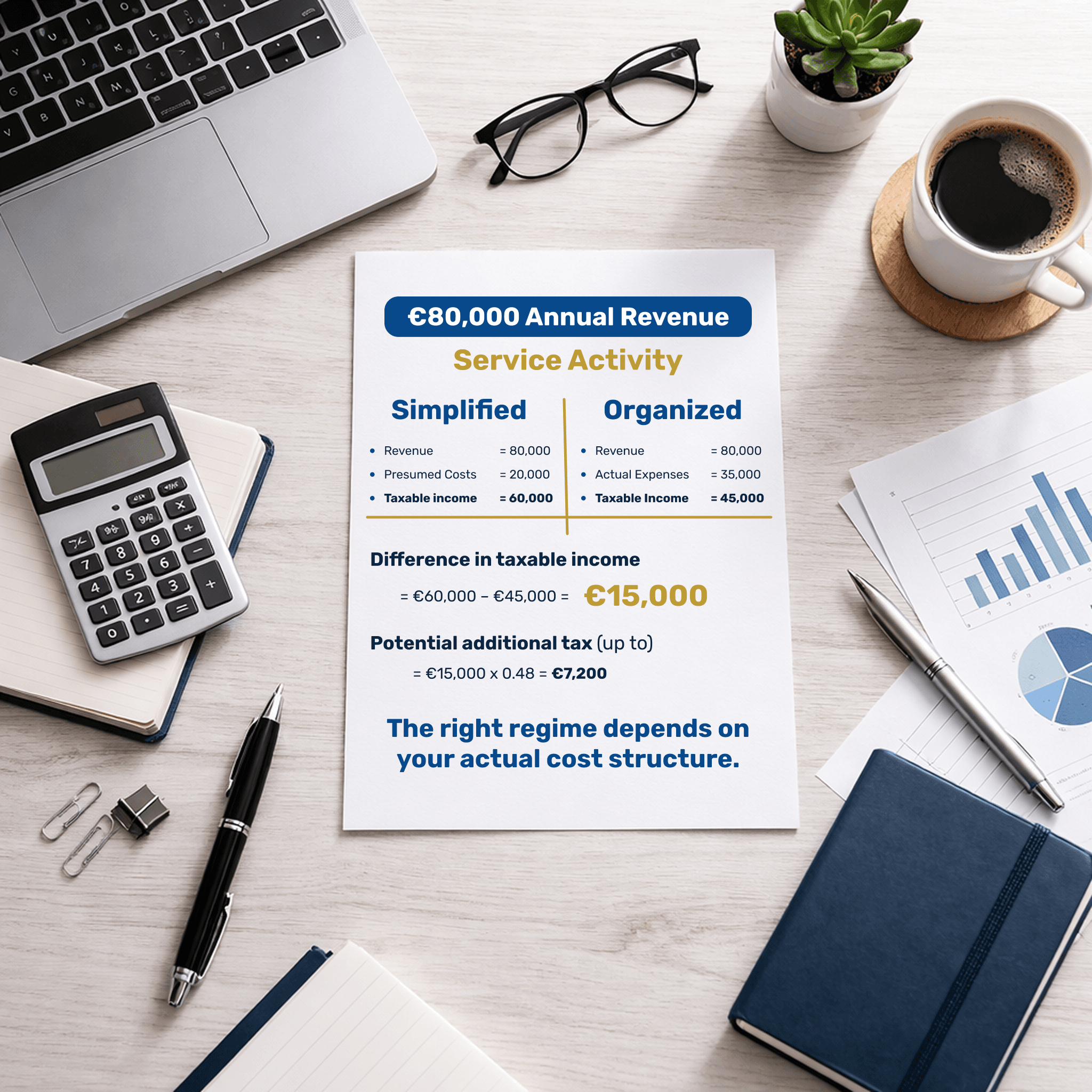
Revenue: €80,000
Real expenses: €35,000
Under Simplified Regime (assuming a 75% taxable coefficient):
Taxable income = €80,000 * 75% = €60,000
Under Organized Accounting:
Taxable income = €80,000 – €35,000 = €45,000
Difference in taxable income: €60,000 – €45,000 = €15,000
That €15,000 is taxed at marginal IRS rates.
At higher income brackets, rates can reach up to 48%.
If part of that difference falls into higher marginal bands, the additional tax cost can easily reach several thousand euros.
What Many People Get Wrong
- Assuming the simplified regime is always cheaper
- Switching to organized accounting too early without a clear economic reason
- Ignoring how income growth changes efficiency
- Looking only at accounting fees instead of total net outcome
In many cases, the difference in accounting fees is small compared to the tax impact of choosing the wrong accounting regime.
A Simple Checklist
You should review your regime if:
- Annual gross revenue exceeds €55,000 (service activities) or €65,000 (short-term rentals)
- Real expenses exceed 25% (service activities) or 35% (short-term rentals) of revenue
- You are hiring or subcontracting
- You are considering forming a company
- Your effective tax rate feels disproportionately high
This review should be based on your activity’s actual financial figures.
Simplified vs Organized Accounting
Final Words
For many freelancers, the simplified regime works well — until it doesn’t.
The question to ask when comparing regimes is:
“Which structure leaves me with more net income after tax and compliance fees?”
That answer changes as your activity grows.