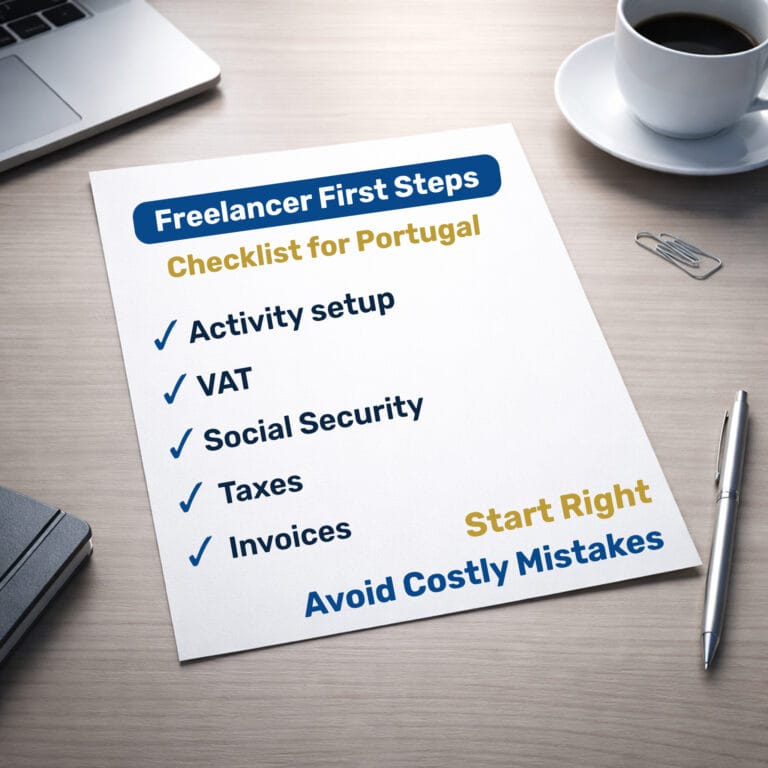
Under the simplified regime, your taxable income is calculated using a fixed coefficient (e.g., 75% or 35% for many service activities) but there are some justification requirements that you must meet in case of a tax audit.
So what freelancers and businesses need to ask is: “Will this expense help me meet the ‘justification’ rules?”
So, in the simplified regime the goals are to:
- validate/allocate expenses correctly
- hold the appropriate doccumentation to justify these expenses
- hit the justification requirements
What “deductible” means in the simplified regime
If you are in a service activity the law assumes part of your income covers expenses (25% or 65% depending on the activity).
But there is a catch: part of that assumed deduction is conditional on you having (and identifying) enough documented business expenses. You must justify 15% of your annual gross-iconme.
If you properly document and identify enough qualifying expenses, you keep the intended benefit of the simplified regime.
If you don’t, your taxable income can increase and so will your taxes.
Many people think “simplified = no need to care about expenses”. This is a complex topic but this is true when your income is small but often false once income grows.
As a rough rule of thumb, the justification requirements become relevant to you when your gross-income is greater than €30,500 in 2026.
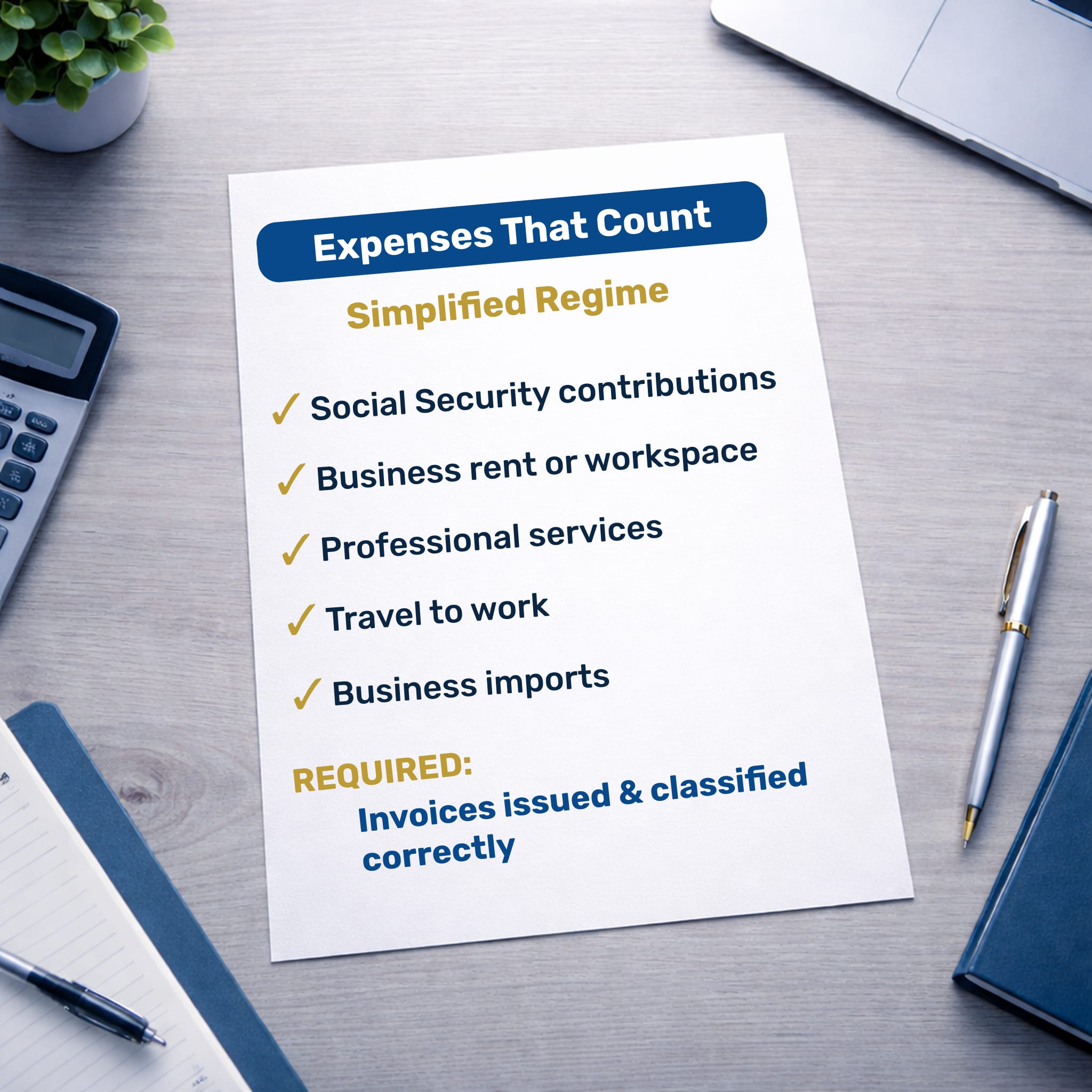
The expense categories that count
For the 0.75 / 0.35 service coefficients, the qualifying items include:
1) Social Security
The greater of:
- a specific deduction amount (€4,587.09 in 2026), or
- the mandatory Social Security contributions connected to the activity.
Social Security often “covers” a meaningful part of the justification requirements by itself for many freelancers.
2) Staff costs (if you have employees)
Salaries and remuneration-related costs that are properly reported.
3) Rent of a property used for the activity (if you have one)
Rents for premises allocated to the activity (supported by invoices/documents communicated to the tax authority).
4) A notional cost for property you own (if used for the activity)
Instead of rent, the law allows a percentage of the VPT (valor patrimonial tributário) for properties allocated to the activity
Note that a higher percentage is allowed for short-term rental operators.
5) “Other expenses” related to the activity
This is where most items fall, as long as they are related to the business activity and supported by proper invoices.
Some examples:
- consumables/materials
- electricity, water
- transport and communications
- insurance
- leasing rents
- professional and legal fees
- travel and stays
- business imports
Mixed-use expenses – the “25% rule”
If certain expenses are only partially used for the activity the law provides that some categories are considered at only 25%.
Common example: if you work from home, you may still have qualifying expenses (utilities, communications), but you often only get partial recognition.
What it must be done in practice (otherwise it won’t count)
To have these expenses considered, you generally need two things:
Correct invoices (with your NIF)
If the invoice isn’t issued properly, it usually won’t count. If the invoice was issued with the wrong NIF, the supplier can usually cancel it and issue a new one with the correct NIF at your request.
Identify them as business-related (on the Portal / e-Fatura)
The law explicitly requires identifying invoices that are exclusively or partially related to the activity, within the relevant deadlines, through the Portal.
The most common mistakes
- Having invoices but not marking them as a business expense → you lose the benefit
- Assuming all expenses are “deductible” like in organized accounting → different tax regime
- Not understanding partial allocation → you overestimate your expenses and get a surprise tax bill
A simple “tax efficiency” checklist
If you’re under the simplified regime, do this:
- Always request invoices with your NIF for business spending
- Each month: validate and mark professional invoices
- For home office costs: be conservative and use partial where appropriate
- Track the few categories which have greater contribution for the justification requirements:
- Social Security
- Rent
- Core business costs (software, communications, insurance, professional dues, travel when justified)
- Once revenue grows (or you’re consistently missing the “justification” threshold), run a comparison: simplified vs organized accounting
Final thought
The simplified regime works well for many freelancers.
But to get the full benefit out of it you must treat your expenses seriously.
Keeping the right invoices and identifying them correctly is often the difference between paying the tax you should pay and paying more than necessary.