Missing tax deadlines in Portugal leads to penalties, cash flow disruptions, or unexpected tax outcomes.
This article is a practical checklist of the deadlines that matter most for freelancers and small businesses.
For the official deadline list use the Agenda Fiscal (Portal das Finanças).
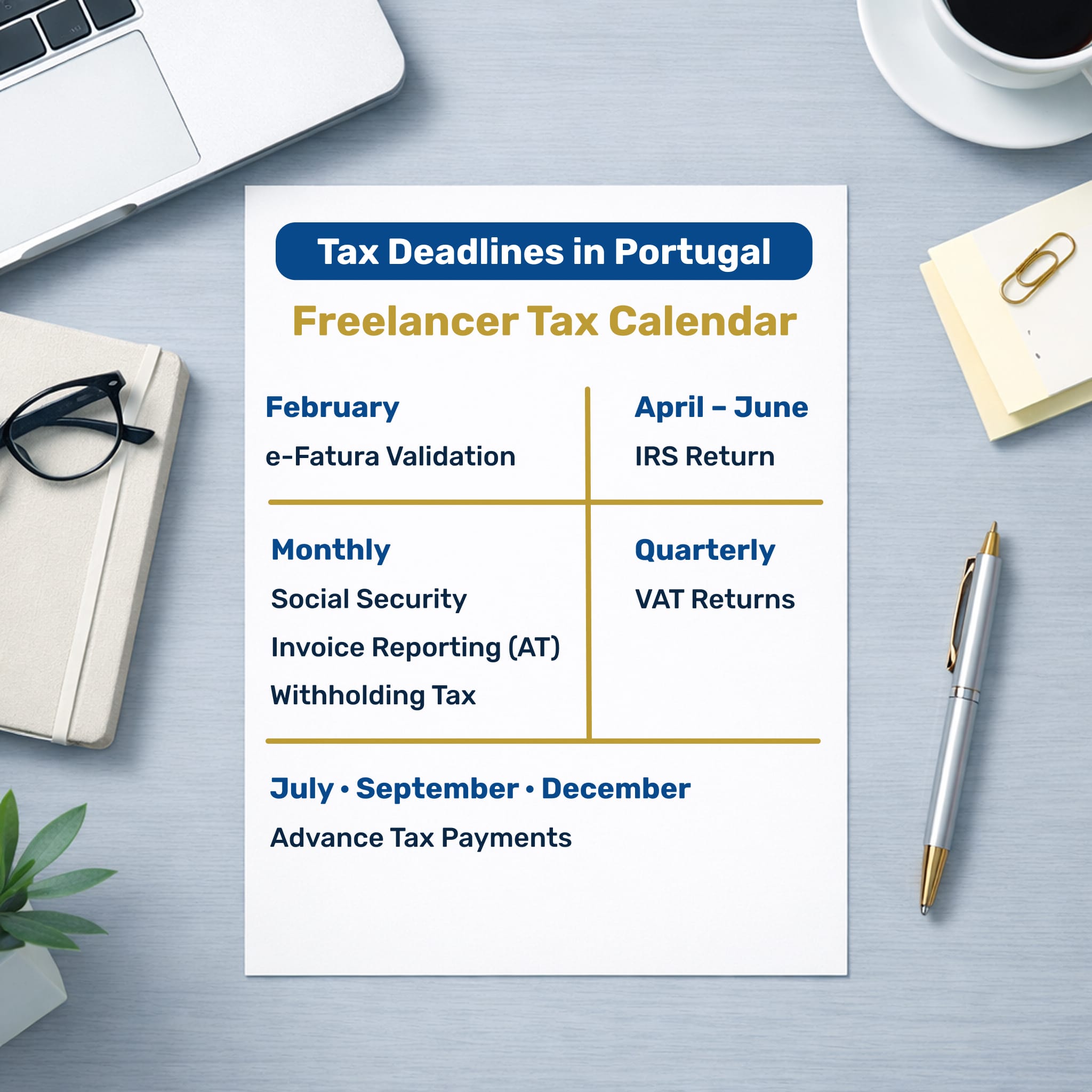
1) e-Fatura Validation
Every year, expenses recorded on the e-Fatura system must be reviewed and validated.
This step confirms whether each invoice should count toward categories such as:
- General expenses
- Health
- Education
- Housing
- Vehicle
- Professional activity
If invoices remain “pending” or incorrectly categorized, they may not be considered when calculating your IRS deductions. This means you could pay more tax than necessary.
For most taxpayers, this validation happens early in the year following the expense year. The deadline varies year-on-year but recently it has been around the first week of February.
How to handle this
At the start of each year, check that:
- all your invoices appear in e-Fatura (both business and non-business related)
- they are categorized correctly
- business-related expenses are properly identified
This is important because it can directly reduce your final IRS bill.
2) The Annual IRS Return (Modelo 3)
Freelancers and sole traders submit their personal income tax return between April and June each year.
This declaration consolidates:
- Business income
- Employment income (if applicable)
- Deductions from e-Fatura
- Other personal income sources
If tax is payable, the payment deadline is typically up to 31 August.
The IRS return filings is an appropriate moment when you can review whether your current tax structure is still efficient.
Analyse the numbers and consider the following:
- Is the simplified regime still appropriate?
- Have expenses increased significantly?
- Has income moved you into a higher marginal tax bracket?
3) VAT Returns (If You Are Registered for VAT)
If you are VAT registered, two deadlines matter:
- Submitting the VAT return (by usually day 20 of the second month after the VAT period)
- Paying the VAT due (by usually day 25 of that same month)
These are separate obligations.
The VAT you collect from clients is not business income. It is tax temporarily held by you on behalf of the state.
One of the most common problems freelancers face is treating VAT as available cash. When the payment deadline arrives, this creates unnecessary pressure on cash flow.
How to handle this
Some businesses find that one of these two approaches work well:
- Save the VAT money immediately in a separate account
- Review your VAT position monthly so you can be aware of how much you will pay and whether you are prepared for it
4) Social Security Contributions
Freelancers pay Social Security contributions monthly, between the 10th and 20th of each month.
These contributions are typically calculated from quarterly declared income and must be paid during the month following the activity period.
Although the amounts are often predictable, missing these payments can generate:
- Late payment interest and additional charges
- Debt collection actions from Social Security
- Restrictions or complications when dealing with public entities
How to handle this
Choose a fixed monthly “admin day” where you check the Social Security portal and confirm that all payments are up to date.
You could also set up a direct debit (if this payment method is available) so you don’t have to worry about this.
5) Monthly Invoice Communication to the Tax Authority (AT)
Freelancers and sole traders issuing invoices must ensure that invoice data is communicated to the Portuguese Tax Authority (AT).
If you issue invoices through certified invoicing software, this communication normally happens automatically.
However, if invoices are issued manually or through systems that do not automatically report them, the invoice must also be submitted monthly through the AT portal.
The communication typically covers the invoices issued during the previous month.
The deadlines vary by month (but it is typically up to 5th of every month).
How to handle this
Each month, you must confirm that:
- All invoices have been issued correctly
- They appear in your invoicing system
- The information has been transmitted to AT
6) Withholding Tax (Retenções na Fonte)
Freelancers must typically apply withholding tax on payments made to other professionals to later pay to the tax authority.
This usually happens when hiring another freelancer or independent contractor to help out in some project.
How to handle this
Before paying a contractor, confirm:
- Whether withholding tax applies to the service
- Whether the contractor has an exemption in place
- Whether the correct withholding tax percentage is applied
7) Advance Tax Payments (Pagamentos por Conta)
Once your activity has been running for some time, the tax authority may require advance payments (“pagamentos por conta”) toward your future IRS liability.
These payments only begin once the tax authority has sufficient historical information about your income – payable from your third calendar year of activity and if your income in the prior year is greater than €15,000.
The payments dates are 31 of July, 30 of September and 15 of December.
Without planning, these can create cash-flow pressure since they come in addition to the other regular tax obligations.
How to handle this
Setting aside a portion of income for tax throughout the year usually prevents these payments from becoming a surprise.
What Happens If You Miss a Deadline?
Consequences may include:
1) Fines
Late filings or missed submissions typically trigger automatic administrative penalties.
These fines often start relatively small but can increase with continued delays.
2) Interest on Late Payments
If tax payments such as VAT or Social Security are made after the deadline, interest is applied to the outstanding amount.
The longer the delay, the higher the cost.
3) Loss of Tax Benefits
Some deadlines directly affect your tax outcome.
For example:
- Unvalidated invoices may not count toward deductions
- Certain corrections become harder after filing deadlines
This means missing a simple administrative step can translate into an higher tax bill.
4) Increased Attention From the Tax Authority
Repeated delays or inconsistent reporting can increase the likelihood of:
- Requests for clarification
- Additional administrative checks
- A tax audit
I am sure most freelancers would prefer to avoid this.
Final Thought
Tax deadlines are part of the broader structure that determines:
- How much tax you ultimately pay
- How predictable your cash flow remains
- How much time you spend dealing with compliance issues
Stay on top of your deadlines to increase your take-home pay.