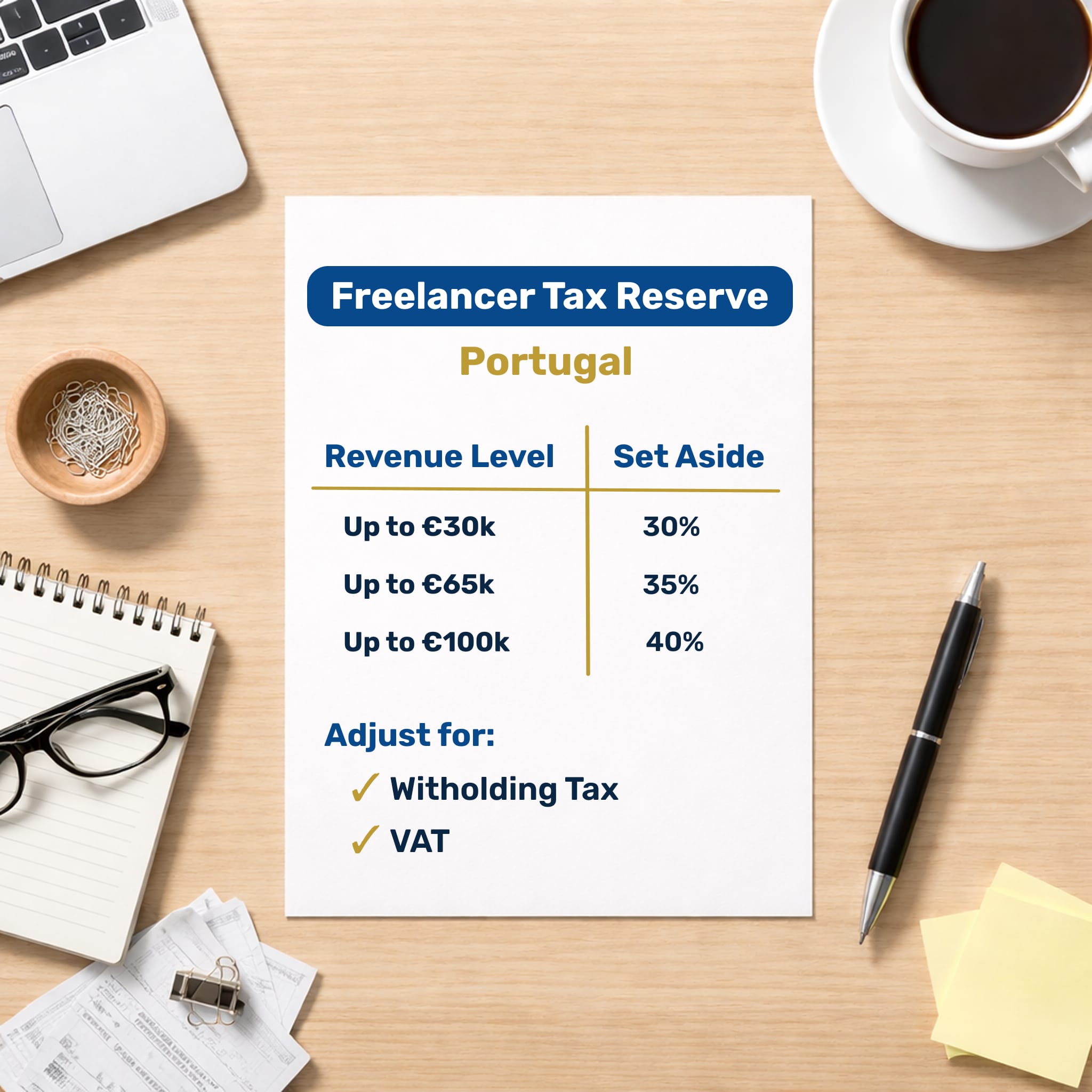
Most freelancers should save 30%–40% of their gross revenue on a monthly basis. Where you land inside that range depends on:
- your Social Security
- your IRS bracket
- whether you’re in the simplified or organized accounting regime
- your withholding tax requirements
This article gives you a simple way to estimate it without becoming a tax technician.
The main “buckets”
1) Social Security
For most self-employed workers, contributions are calculated based on 70% of total income, and the standard contribution rate is 21.4%.
That translates to an effective 15% of gross revenue in many cases (because 21.4% × 70% ≈ 15%).
Note that, in Portugal, Social Security contributions only become due after the first full year of activity.
2) IRS (income tax)
IRS is progressive. The amount depends on your taxable income, not your revenue.
If you’re in the simplified regime, the taxable income is calculated by applying a coefficient to gross income. For many professional services, the commonly used coefficient is 0.75 (i.e., 75% of revenue is treated as taxable income).
Under organized accounting, taxable income is based on actual profit (revenue minus deductible business expenses). This means your tax depends on your real cost structure rather than a fixed coefficient.
IRS then applies progressive rates to your taxable income which can go up to 48%.
But your exact outcome will still depend on your family situation, whether you have any dependants, other deductions (very broad topic), where you live, your non-business related expenses in e-Facturas, etc.
For example, if you are taxed jointly with a partner who earns less income, the overall IRS burden is usually lower. Having dependants also usually reduces the effective IRS tax rate.
This means that your income tax bill is not a fixed percent of revenue. But one thing is certain: it rises as your taxable income rises.
3) VAT – only if you charge it
If you have to charge VAT on your invoices, you’re basically collecting tax for the State and later paying over the net amount due.
Practical implication:
If you charge VAT, treat it as money you’re holding temporarily. Keep it separate from day-to-day cash.
Tax withholding changes the cash you need to save
Some businesses clients withhold tax on your behalf (retenção na fonte). If that happens, part of your IRS is already being pre-paid during the year.
For many professional services, the withholding rate is 23% of the invoice value (excluding VAT) when invoicing businesses.
Practical implication:
- If you invoice €1,000 and the client withholds €230, you don’t need to set aside the full IRS portion again — but you still must plan for Social Security and any year-end IRS difference.
- If you have no withholding, your set-aside discipline matters more.
A rule-of-thumb set-aside cash
This is a conservative calculation.
Step 1) Set aside Social Security first
After their first year of activity, most freelancers should reserve approximately:
- 15% of gross revenue
This covers the Social Security contribution for self-employed workers and assumed there you are not facing a decrease of your revenue in the current months.
Step 2) Add an IRS buffer based on income level
This is complex but as a practical starting point (assuming the simplified accounting regime with a 75% coefficient and no dependants):
- Annual revenue up to €30,000: add 10%–15% of revenue
- Annual revenue up to €65,000: add 15%–20% of revenue
- Annual revenue up to €100,000: add 20%–25% of revenue
These figures are based on actual numbers but their calculation falls outside the scope of this article given its complexity.
Step 3) Adjust for Any Withholding
If your clients withhold IRS from your invoices (for example, 23%) you should reduce the amount you set aside accordingly.
This means that, for example, if your set-aside rule suggests 25%, but your client withholds 23%, you would only need to reserve 2% for IRS.
Step 4) Keep all VAT collected
If you charge VAT, do not treat VAT as income.
Keep it separate from your operating cash.
Final Calculation
For most freelancers operating under the simplified regime:
Typical set-aside levels fall roughly around:
- 30% of revenue → income up to €30,000
- 35% of revenue → income up to €65,000
- 40% of revenue → income up to €100,000
Then adjust by:
- Subtracting any tax withheld by clients
- Adding any VAT collected
This amount should be held in a separate bank account.
A Practical Example
Assume a freelancer invoices €4,000 per month (€48,000 per year) net of VAT and operates under the simplified regime with no dependants.
Step 1 — Social Security
Set aside 15% of revenue.
€4,000 × 15% = €600
Step 2 — IRS Buffer
At this income level (around €48,000 per year), a reasonable buffer is 20% of revenue.
€4,000 × 20% = €800
Step 3 — Total Monthly Set-Aside
€600 (Social Security) plus €800 (IRS buffer)
Total: €1,400
The freelancer should reserve roughly 35% of revenue.
Step 4 — Adjust for Withholding
If the clients withhold 23% IRS at source:
€4,000 × 23% = €920 already withheld
In that case, the freelancer only needs to reserve the remaining amount:
€1,400 − €920 = €480
Step 5 — If VAT Is Charged
If the freelancer also charges 23% VAT then the invoice total would be €4,920.
The €920 VAT should be kept separate and not treated as income.
The freelancer should reserve a total of €1,400 (€480 plus €920).
Final thought
One of the biggest mistake freelancers make is treating gross income as spendable income.
Taxes in Portugal arrive later and in multiple layers. Without a system, it is easy to underestimate what will eventually be due.