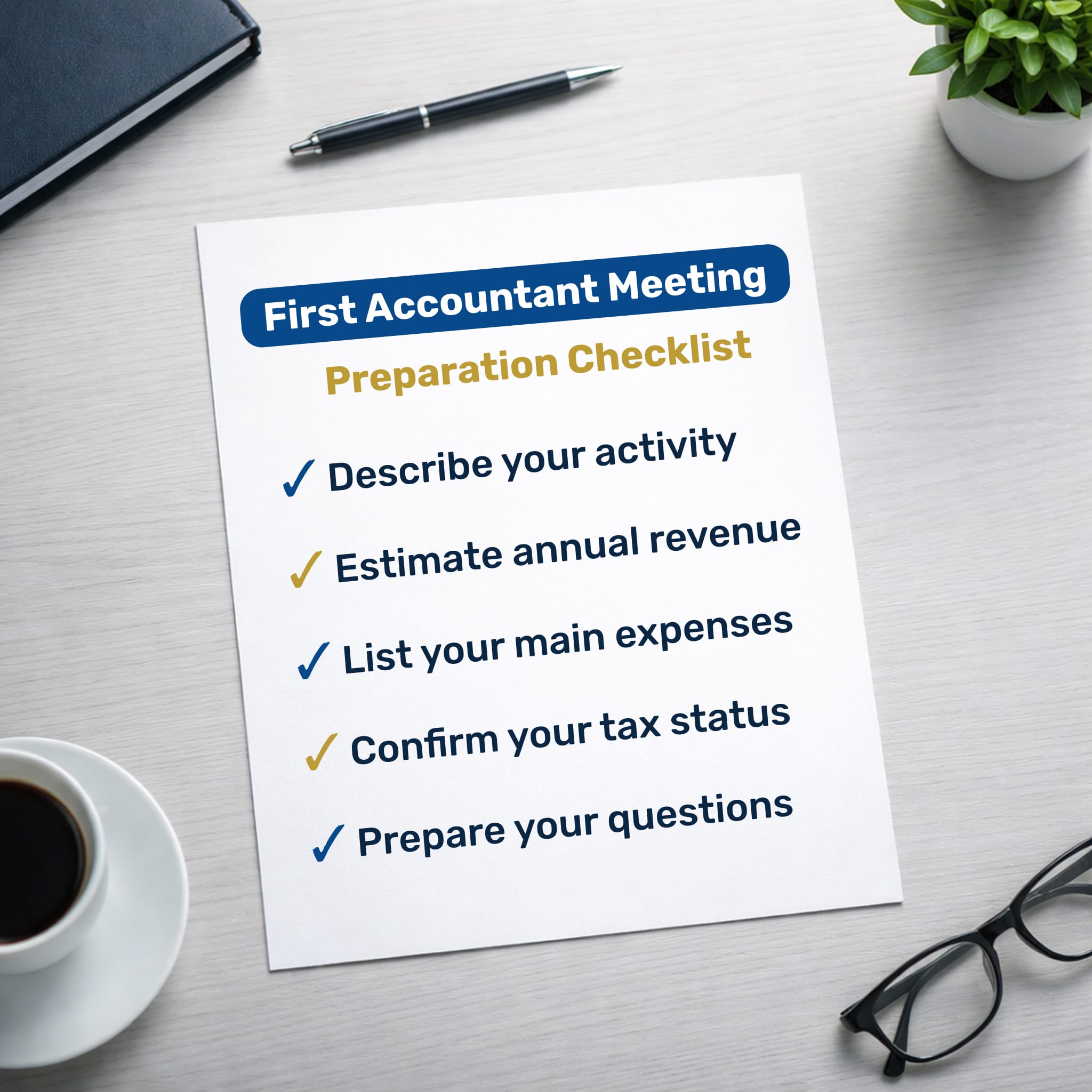
Come prepared with a clear picture of your activity, your income, and the questions you actually need answered.
A first meeting with an accountant should help you understand where you stand, what applies to you, and what decisions are worth making.
Meetings become more useful the better prepared you are.
What the First Meeting Is Really For
Many people assume the first meeting is just about paperwork.
However, a good first meeting should help clarify:
- how your activity is taxed
- what registrations or obligations apply
- what needs attention now
- what can wait
- where tax mistakes or inefficiencies usually begin
The goal is to leave you with a clearer plan.
Important: Do not hide uncertainty
If your income is irregular, your costs are unclear, or you are still deciding how to operate, say so. That is normal. The meeting is there to help clarify it.
What to Bring to the Meeting
You do not need a perfect file. But you do need the basics.
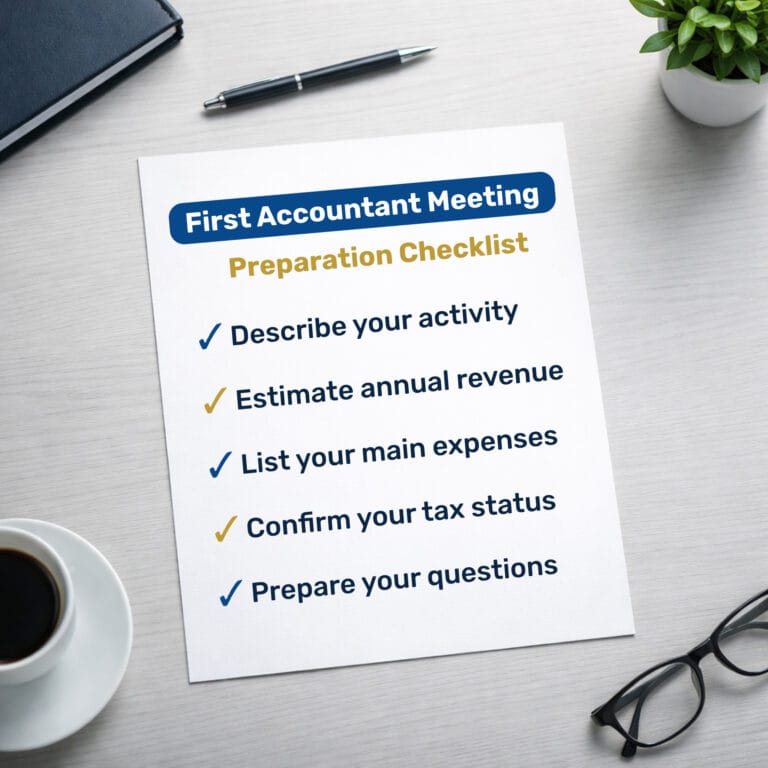
1) A simple explanation of what you do
Be ready to explain:
- what type of work or business you do
- who your clients are
- whether you provide services, sell goods, or both
- whether you work only in Portugal or also with foreign clients
- whether your activity is occasional, growing, or already established
This matters because the tax treatment often depends on the activity.
2) An estimate of your expected revenue
You do not need exact numbers. A realistic estimate is enough.
Try to give:
- expected monthly revenue
- expected annual revenue
- whether income is regular or uneven
- whether you expect growth in the near future
This helps assess issues such as VAT, Social Security, withholding, and whether your current structure is still efficient.
3) A rough idea of your costs
This is one of the most useful parts of the discussion.
Bring a simple list of your likely business costs, such as:
- software and subscriptions
- equipment
- travel
- rent or coworking
- subcontractors
- insurance
- phone and internet
- vehicle costs, if relevant
You do not need a spreadsheet with perfect detail.
But if you want good tax advice, the accountant needs to understand whether your activity is low-cost or expense heavy.
This matters a lot because a more efficient setup might be available depending on your costs.
4) Your current setup
Be clear about your current position.
For example:
- Have you already opened activity?
- Are you registered for VAT?
- Are you under the simplified regime?
- Do you already have a company?
- Are you issuing invoices already?
- Are you receiving income from abroad?
A first meeting is much more useful when the starting point is clear.
Questions You Should Ask
This is where many people waste the opportunity.
They leave a first meeting knowing what forms they need to submit but there is usually little focus on what actually affects their net income.
A better approach is to ask questions like:
1) Is my current structure the most efficient one?
Do not just ask whether your setup is valid. Ask whether it still makes sense.
For example:
- Is the simplified regime appropriate for my income and costs?
- Would another structure likely become more efficient if revenue increases?
- Is there anything you would like me to review so you can give me a more complete answer?
2) What taxes should I expect in practice?
For a realistic picture you could ask stuff like:
- What should I set aside for tax?
- Will I have to pay VAT, IRS, Social Security, IRC?
- When will I have to make these payments?
This helps avoid the common mistake of confusing revenue with available income.
3) What are the main risks or mistakes in my situation?
This question is often more useful than asking for a full technical explanation.
For example:
- What do people in my position usually get wrong?
- Are there deadlines I should already know about?
- Is there anything I am doing now that could create tax problems later?
These kinds of questions make for a very practical conversation.
4) What do you need from me on an ongoing basis?
A lot of accounting problems are caused by poor communication and unclear responsibilities.
Ask:
- What documents do you need and how often?
- What do I need to keep track of myself?
- How should I send information?
- Can I contact you before making a decision?
Why This Matters
The first meeting often shapes the accountant’s opinions about your business and may lead to subpar advice that can become expensive to correct later.
A good first meeting does the opposite.
It gives you clarity early, reduces avoidable mistakes, and helps you make decisions with a better view of the tax consequences.
Final Thought
You do not need to arrive with perfect records or technical knowledge. You just need enough information to make the conversation useful.
The right accountant should help you understand what matters, what applies, and what to do next.
Because the value of a first meeting (and an accountant in general) is to guide you towards a clearer and more efficient path forward.