You should consider moving from freelancer to a company when the structure starts limiting either:
- your net income
- your risk control
- your ability to operate cleanly as the business grows.
This decision should not just be about looking “more professional”.
What actually changes when you incorporate?
As a freelancer, you and the business are effectively the same person for tax purposes. You are taxed under IRS rules, and your personal position is tightly linked to business results.
As a company, the business becomes its own legal entity:
- Profits are generally taxed under corporate rules (IRC)
- You choose how you extract money (salary, dividends, reimbursements, etc.)
- The company’s costs, payroll, and reporting are more structured
- The administrative burden increases — but so does control
The main differences are flexibility and simplicity.
When a company starts to make sense
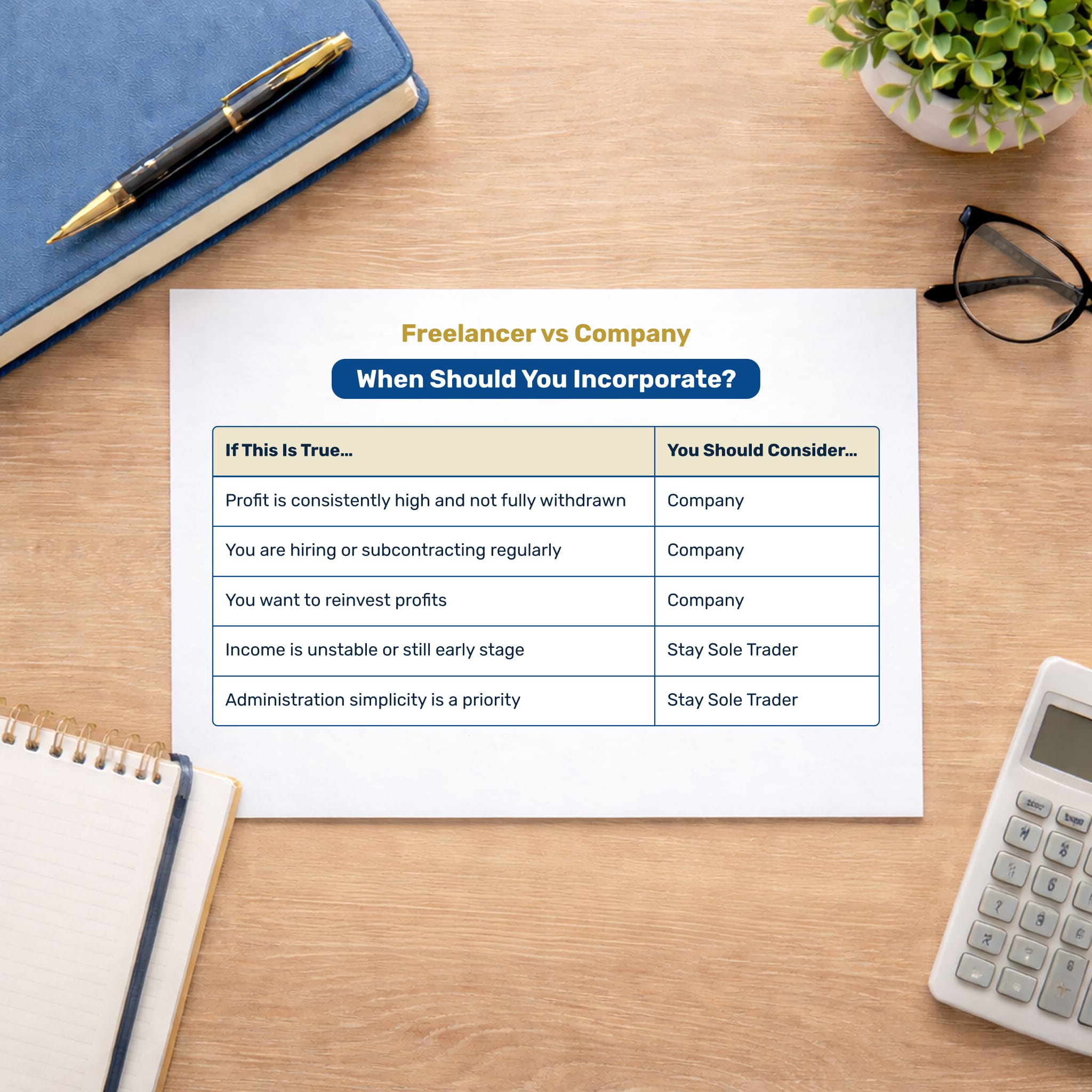
1) Your profit is consistently high (and you don’t need to withdraw everything)
If your activity generates strong profit and you don’t need to take all of it for personal spending, a company can be beneficial because it allows:
- leaving profit in the business to reinvest
- separating business cashflow from personal cashflow
- planning withdrawals more deliberately
This is basically the core of any “tax efficiency” solution — using the option that best fits the economics of your business.
2) You’re hiring, using subcontractors, or building a cost base
When you have employees, regular subcontractors, rent, software stacks, insurance, vehicles, or equipment, managing the financial side of the business becomes harder to handle.
At that point, simply deducting costs may not be enough. You might also want to:
- track them properly
- maintain clear documentation
- understand how these costs affect your overall profitability
Incorporating often supports this operationally better, even before it becomes more tax efficient.
3) Risk and liability are becoming real
Some activities carry meaningful professional, contractual, or operational risk.
A company can provide a clearer separation between your business commitments and your personal assets when structured and run correctly.
This becomes highly relevant if:
- you’re signing bigger contracts
- working with larger clients
- taking on longer commitments
4) Your pricing has moved beyond “time-for-money”
Many freelancers start with simple billing based on hours or individual projects. As services evolve into retainers, packages, subcontracted delivery, or multi-person operations, a company can match that complexity better.
If you are selling your time, a freelancer structure often works well.
If you are building a system that generates revenue beyond your own hours, a company structure may fit better.
5) Your personal tax outcome feels disconnected from “common sense”
This is one of the most common triggers.
You grow, you work more, you earn more — but your effective tax burden rises faster than expected.
Sometimes that’s normal (higher marginal tax rates). Sometimes it’s a sign the structure needs review.
In this case you simply need to run the numbers to get a clean comparison.
When you should not rush into a company
1) Your revenue is still unstable
If income is unpredictable and you’re still validating your market, a company can add fixed overhead and administrative load that does not increase revenue.
2) Your margins are thin
If profit is low because the business is not yet efficient, incorporation rarely fixes that. You typically need better pricing, better cost control, or both.
3) You’re doing it “because someone said it’s better”
A company is not automatically more tax efficient. It can be — but only under the right profit, required withdrawals and cost patterns.
The decision should be based on a numerical comparison
A proper comparison looks like this:
Scenario A — Stay freelancer
- What is your expected taxable income under your current regime?
- What will you likely pay across taxes/contributions?
- What is your net income after compliance costs?
Scenario B — Incorporate
- What is your expected profit in the company after expenses?
- How will you extract money (and how much do you actually need for your day-to-day life)?
- What is the total tax and contribution impact across company + personal side?
- What are the added compliance costs?
Then you choose the structure that produces the best result for your business.
A simple checklist: are you approaching the transition point?
You should run a “freelancer vs company” review if:
- Profit is consistently strong (not just one good month)
- You don’t need to withdraw all profit
- You’re hiring / subcontracting regularly
- You are taking on larger contracts or longer commitments
- You want clearer reporting and control
- Your effective tax burden feels disproportionate
- You are planning to scale beyond yourself
If two or three of these points apply, it’s usually time to run the numbers.
Final thought
Freelancer can be perfectly efficient if you are operating as a solo professional with straightforward billing,
But as profit, risk, or operational complexity increase, the additional structure of a company can provide better control and help protect net income.