You reduce your tax legally by choosing the right structure early, keeping clean documentation, and making sure your income is taxed in the most efficient way available for your situation.
Step 1: Know what actually drives your tax bill
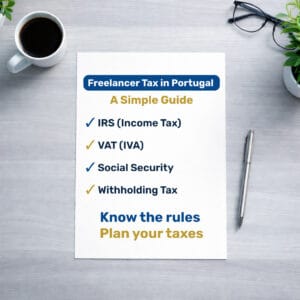
As a freelancer in Portugal, your net outcome is usually driven by four things:
- Your tax regime (simplified vs organized accounting)
- Whether you charge VAT (and whether you can recover it)
- How your income is classified and reported (activity code, invoices, clients, platforms)
- Social Security contributions (how they are calculated and how stable your income is)
Step 2: Choose the right tax structure
A) Stay in the simplified regime when it’s efficient
For many service freelancers, the simplified regime is efficient because only part of your revenue is treated as taxable income.
This works best when:
- your real expenses are modest
- you sell time/skills rather than materials
- you don’t subcontract heavily
Common error: staying on simplified when your costs have grown. At that point you may be paying tax on “profit” you didn’t really have.
B) Move to organized accounting when your costs justify it
Organized accounting becomes attractive when your business expenses are high relative to revenue.
Typical triggers:
- you start subcontracting
- you want to start hiring employees
- you have considerable business expenses (e.g. subcontractors, office, equipment, third-party fees)
In these cases, organized accounting can significantly reduce your tax bill.
C) Consider a company only when the numbers support it
A company can reduce tax in some cases, but it’s not automatically better.
Usually it becomes relevant when:
- profit is consistently high
- you want to retain earnings inside the business
- you have considerable business expenses
- you have more structured operations
- you want stronger separation between personal and business planning
Common mistake: incorporating too early and ending up paying more in accounting, compliance, and dividend taxes than the tax saved.
Step 3: VAT
VAT is not meant to be an “extra tax on you”. But it can change your pricing, your margins, paperwork, and whether you can recover VAT on costs.
You reduce your surprises by being clear on:
A) Whether you must charge VAT
If you are required to charge VAT, failing to do so can become an expensive problem later as VAT not charged becomes your cost.
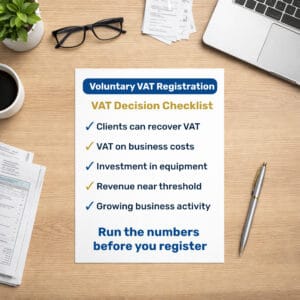
B) Whether VAT registration can be beneficial — even if not mandatory
Sometimes voluntary VAT registration makes sense if:
- your clients are mostly businesses who can recover VAT, and
- you have meaningful VAT-bearing costs (equipment, software, professional services)
In that case, being VAT registered can improve your net position because you may recover VAT on expenses and can easily incorporate VAT on your invoices.
Warning: if most clients are consumers, charging VAT can make you less competitive unless you adjust pricing accordingly.
Step 4: Make sure to keep your records clean
Your tax outcome depends on whether your regime properly reflects your business expenses.
If you are in organized accounting, your report expenses, and thus improve your net income when:
- costs are business-related
- expenses are properly classified
- documentation is complete
If you are in the simplified regime, clean records still matter because:
- certain thresholds and compliance rules still apply (relevant in the case of a tax audit)
- you may switch regimes later (giving you history when switching regimes)
- you need to know when simplified stops being efficient
Important: If using the simplified regime, poor documentation is often the difference between an expense being accepted or rejected during a tax audit.
Step 5: Avoid poor invoicing and weak classification
Some people lose money here for no reason.
Make sure that:
- your activity code and service description match what you actually do
- invoices are issued correctly and on time
- you keep a dedicated business account (even if not legally required)
- you separate personal and business payments
This prevents compliance problems and keeps your tax planning options open.
Step 6: Use timing intelligently
Tax planning often comes down to timing:
- When you invoice
- When you incur legitimate business costs
- When you make major purchases
- When you transition regimes or incorporate
Example: buying equipment before or after switching regimes can change whether the expense actually reduces your tax bill.
Step 7: Social Security
Many freelancers focus only on IRS and VAT, then get surprised by Social Security.
Good planning means:
- reviewing Social Security alongside your IRS situation
- anticipating the cash-flow impact of adjustments (typically quarterly for Social Security contributions)
- considering how income volatility affects contributions
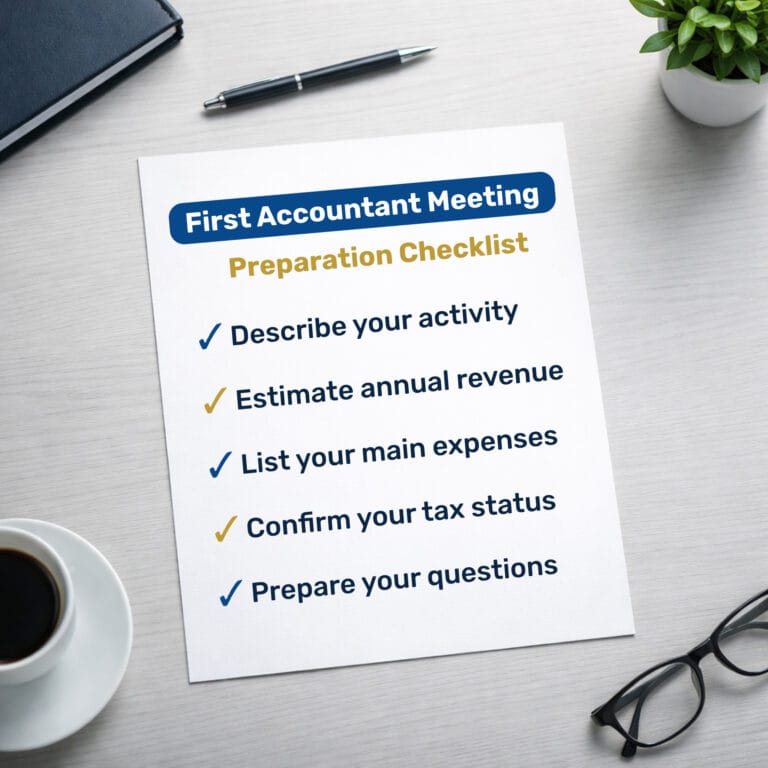
A good accountant can help you estimate upcoming Social Security contributions so you are not surprised by future payments.
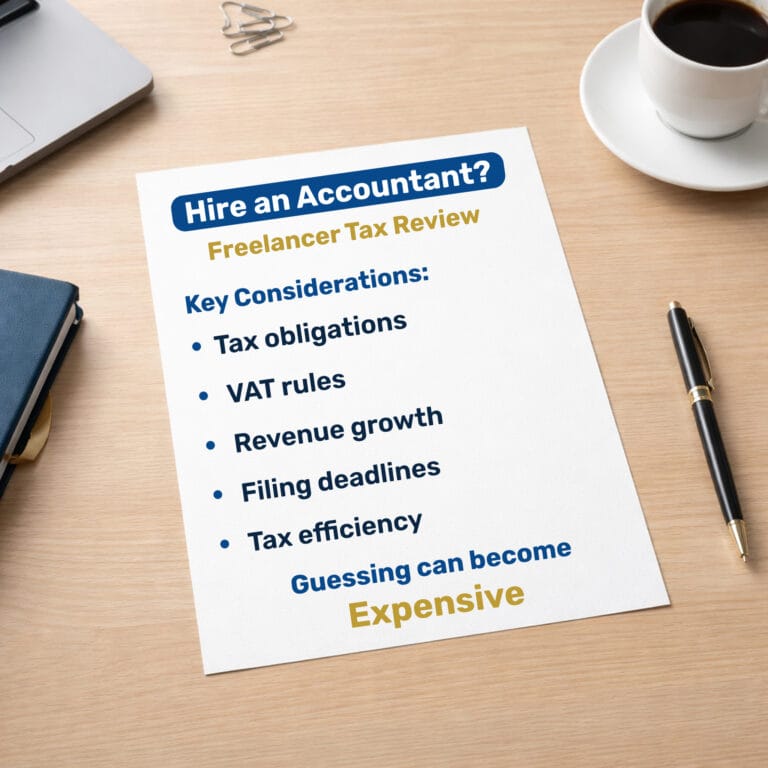
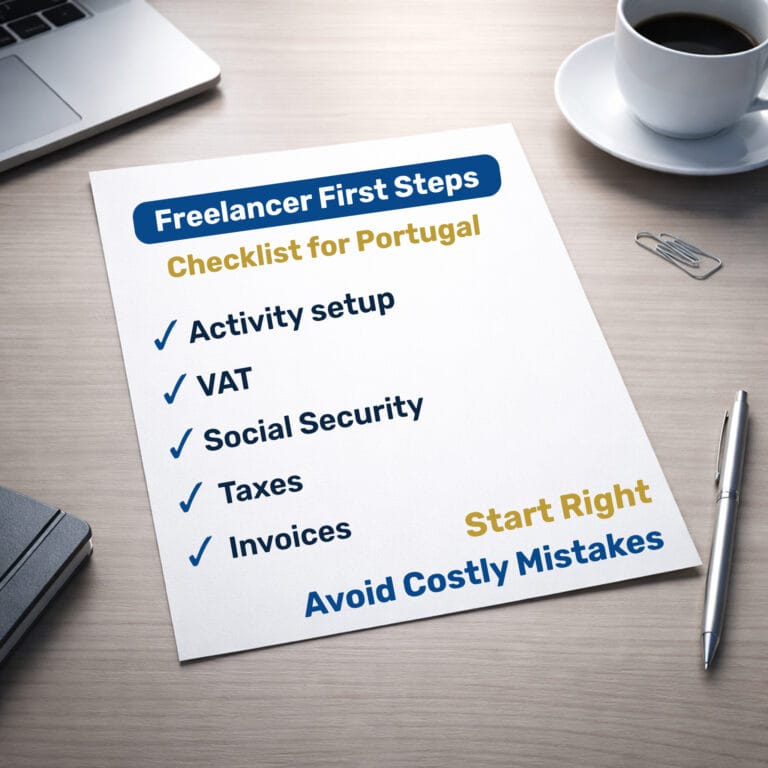
A simple “tax efficiency checklist” for freelancers
If you want to reduce your taxes legally, review these points at least quarterly:
- Am I on the right regime for my current income and cost structure?
- Have my expenses grown enough that simplified is no longer efficient?
- Do I need to charge VAT — or would voluntary VAT registration help?
- Am I invoicing my clients properly?
- Are my income and expenses stable enough that incorporation could make sense?
- Do I understand my Social Security commitments?
If you can’t answer one of these confidently, you may be paying more tax than you should.
Final thought
Reducing your tax bill as a freelancer in Portugal usually comes down to structure.
The best outcomes tend to come from:
- choosing the right tax regime for your situation
- keeping your records and invoicing consistent
- reviewing key decisions before the year ends (not after)
Small structural choices can significantly affect how much of your income you actually keep.