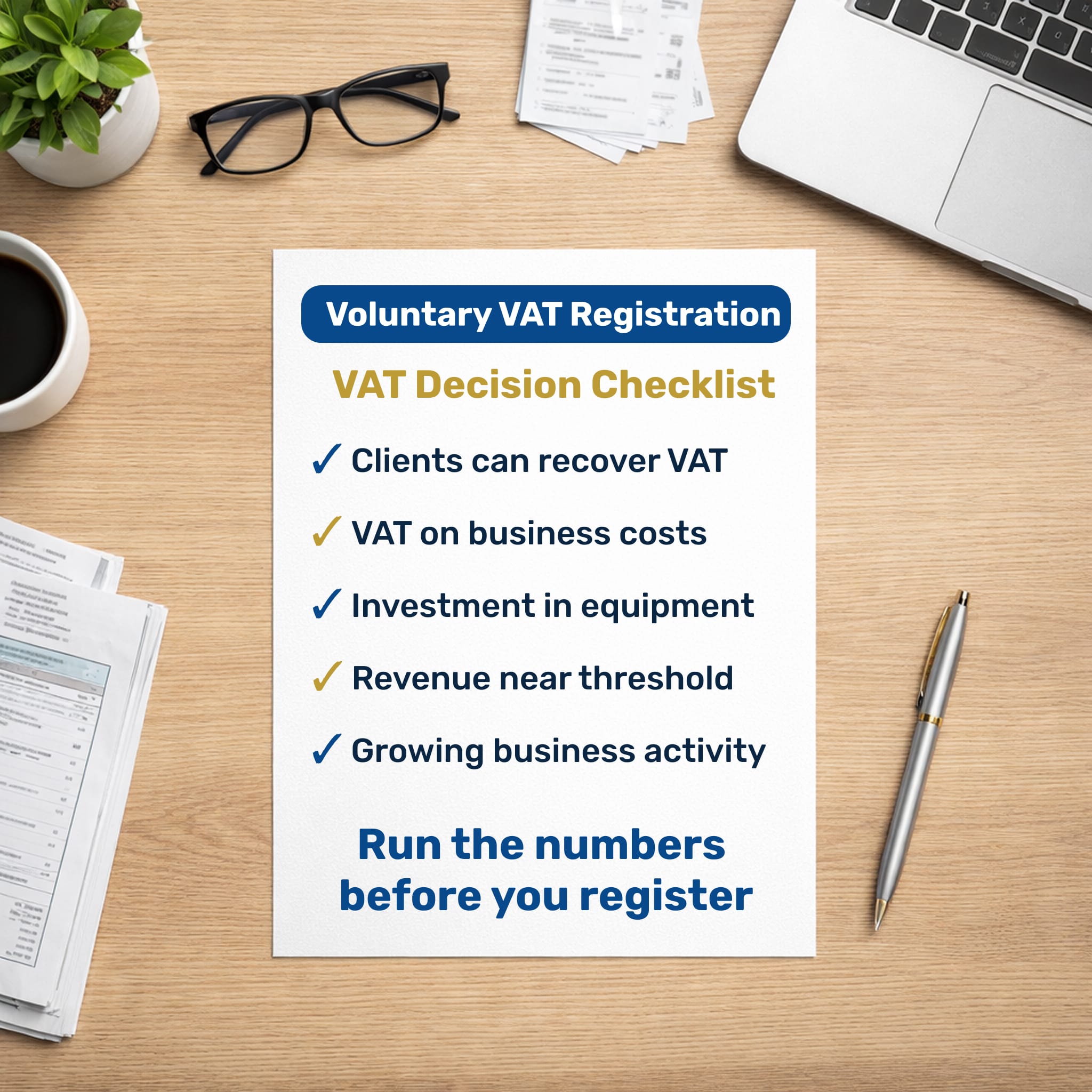
You should only register voluntarily if it improves your net position because you can recover meaningful VAT on costs and charging VAT will not hurt your pricing.
Otherwise, VAT registration adds admin with no upside.
Are you actually exempt right now?
Many freelancers and small operators start under the VAT exemption regime (Article 53 of the VAT Code), which applies when your annual turnover in Portugal in the previous calendar year is not above €15,000 (subject to various conditions).
If you qualify, you can issue invoices without charging VAT, and you generally do not submit regular VAT returns. That simplicity has value.
Voluntary registration means you give up that simplicity.
Understand the trade-off
Voluntary VAT registration is a swap.
If you register for VAT, you typically gain the right to recover VAT on business expenses (your costs, equipment, software, services, etc.).
But you also take on:
- Charging VAT on applicable sales (which can make you more expensive for some clients)
- Regular VAT compliance (returns, classifications, evidence, deadlines)
- More room for mistakes (and correction work)
So you should consider if it leaves you better off after everything is accounted for.
When voluntary VAT registration does make sense
1) Your clients are businesses that can recover VAT
If you mostly sell to VAT-registered businesses:
- You charge VAT
- The client recovers it (in many cases)
- Your commercial price pressure is lower
In these situations, registration can be efficient if you have relevant costs with VAT to recover.
2) You have meaningful VAT on costs (that can actually be recovered)
This is the most common reason to voluntarily register for VAT.
Examples of business-related expenses that can be recovered:
- Equipment purchases (computers, tools, furnishings for an office)
- Professional software subscriptions and services
- Subcontractors
- Rent and operational expenses (depending on the case)
- Higher upfront setup costs (new activity, investment phase)
If your input VAT is small, this benefit is often not worth the extra admin requirements.
3) You sell services internationally
For many cross-border services, VAT treatment can differ depending on:
- where your client is established
- whether the client is a taxable business
- the type of service
- and the evidence you hold
Depending on the actual facts, voluntary registration can be useful or pointless.
If your work is mostly international business clients, VAT registration may still be helpful for recovering VAT on costs.
However, after registering for VAT, there will be new invoicing requirements so this needs to be handled carefully.
When voluntary VAT registration usually does not make sense
1) You sell mostly to individuals in Portugal
If you serve individuals, charging VAT can effectively force you to:
- raise your final price (hurting conversion), or
- keep the same final price (reducing your margin)
In most businesses where you sell mainly to individual clients, voluntary VAT registration is not a profitability decision.
2) Your business has low expenses
If you are a service provider with few costs, the VAT you could recover may be minimal.
In that case, you take on recurring admin and compliance risk for little financial return.
3) You are close to the threshold anyway
If you are likely to exceed the exemption threshold soon, it may be better to plan a clean transition by:
- Understanding how VAT will affect your final price
- Preparing invoicing systems so VAT can be applied correctly
- Understanding your client profile and how suggestible they are to price changes
- Reviewing deductible costs so VAT recovery works properly once registered
VAT rates: why location matters
VAT rates differ by territory. For example, the normal VAT rate is 23% in mainland Portugal and 22% in Madeira (with reduced and intermediate rates also differing).
This matters for pricing and expectations — especially for businesses based in Madeira serving clients across Portugal.
How to decide
Voluntary registration is worth considering if most of the following are true:
- You sell mostly to business customers
- Your clients are price-insensitive to VAT (they can recover it, or VAT isn’t a real commercial issue)
- You have material VAT on costs to recover
- You are making an upfront investment (equipment / setup phase)
- You can keep compliance clean and disciplined and are ready for it
Final Thoughts
VAT registration is a cost/benefit choice.
If it improves your net outcome, do it deliberately and set it up properly.
If it doesn’t, staying exempt is often the most efficient decision.